Last Updated on Aug 15, 2026 by Durga Mishra
Investing in US stocks has become increasingly popular among Indian investors looking to diversify beyond domestic markets. Global giants like Apple, Microsoft, Amazon, and NVIDIA offer exposure to innovation-led growth that is difficult to replicate in India alone.
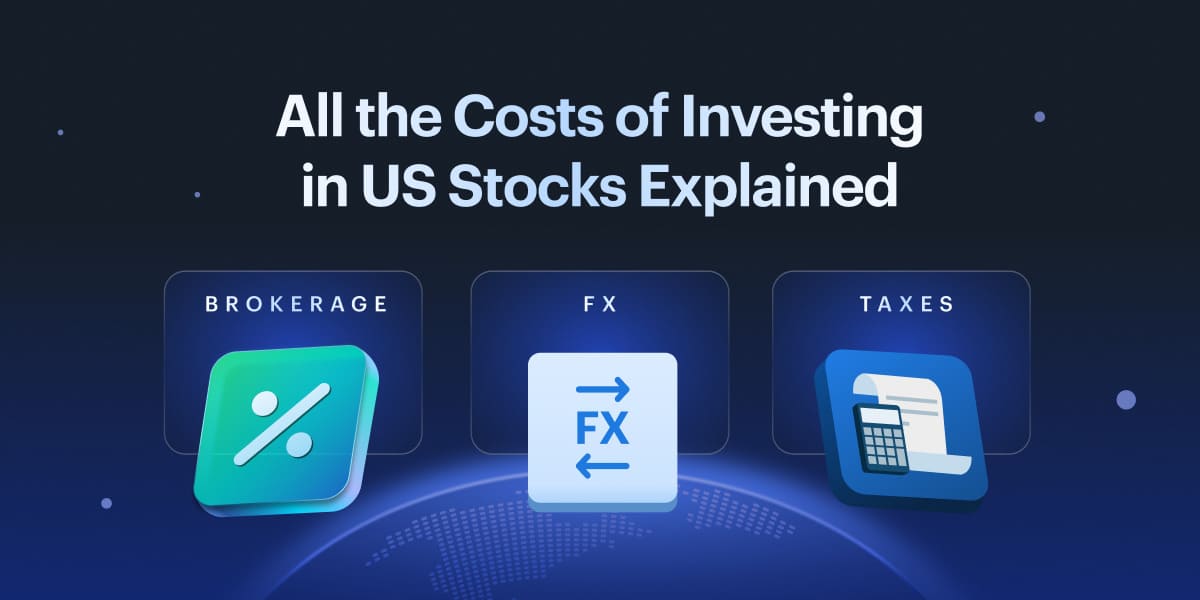
However, while most platforms advertise zero brokerage, the real cost of investing in US stocks goes far beyond buying a share. From foreign exchange markups and international transfer fees to TCS and taxes, understanding the true cost structure is essential before you invest.
In this guide, we break down all the costs of investing in US stocks for Indian investors –
Table of Contents
Total Costs of Investing in US Stocks
Total Cost of Investing in US Stocks =
Platform Fees + FX Charges + Transfer Costs + TCS + Taxes
While platform fees are often zero, other costs can materially impact returns, especially for smaller investments.
- Platform and Brokerage Charges for US Stocks
Most modern platforms offering US stock investing in India have eliminated traditional brokerage costs.
| Platform | Account Opening | AMC | Brokerage | Withdrawal Fee |
| Tickertape | 0 | 0 | 0.20% | 0 |
- Foreign Exchange (FX) Charges
FX markup is the difference between the actual USD-INR exchange rate and the rate offered by banks or platforms during currency conversion. This cost applies:
- When you send money to invest
- When you withdraw money back to India
FX Markup Comparison Across Banks
| Bank / Platform | FX Markup Range |
| Federal Bank | 0.30% – 0.70% |
| HDFC / Axis | 0.40% – 0.80% |
| SBI | 0.60% – 1.20% |
| Interactive Brokers | 0.20% – 0.40% |
FX Cost Example (Rs. 1,00,000 Investment)
A 0.5% FX markup reduces your investable amount by ~Rs. 500 at entry and another ~Rs. 500 on exit, leading to a ~1% round-trip loss, even before considering stock returns.
- International Money Transfer Costs (SWIFT & Intermediary Fees)
Unlike Indian stocks, US stock investing requires international remittances, which attract fixed banking charges.
Typical Transfer Costs Breakdown
| Charge Type | Typical Amount |
| SWIFT fee | Rs. 200 – Rs. 500 |
| Intermediary bank fee | $5 – $20 |
| Receiving bank fee | $0 – $10 |
Why Transfer Size Matters
| Transfer Amount | Total Cost | % of Transfer |
| Rs. 10,000 | Rs. 1,090 | 10.9% |
| Rs. 50,000 | Rs. 1,290 | 2.58% |
| Rs. 1,00,000 | Rs. 1,540 | 1.54% |
| Rs. 2,00,000 | Rs. 2,040 | 1.02% |
- TCS on US Stock Investments
TCS (Tax Collected at Source) applies to foreign remittances exceeding Rs. 10 lakh in a financial year under the Liberalised Remittance Scheme (LRS).
TCS Rates for US Stock Investing
| Annual Remittance | TCS Rate |
| Up to Rs. 10 lakh | 0% |
| Above Rs. 10 lakh | 20% on excess |
Important:
TCS is not an additional tax. It is fully refundable when filing your income tax return.
- Taxes on US Stocks for Indian Investors
A. Dividend Tax on US Stocks
US companies deduct 25% withholding tax on dividends. In India, dividends are taxed as per your income slab, with credit available under DTAA. The effective minimum tax on dividends is 25%.
B. Capital Gains Tax on US Stocks
| Holding Period | Tax Type | Tax Rate |
| Less than 24 months | Short-Term Capital Gains (STCG) | Income slab |
| 24 months or more | Long-Term Capital Gains (LTCG) | 12.5% |
Investing in US stocks isn’t expensive; uninformed investing is.
When planned well, with the right transfer size, holding period, and tax awareness, US equities can meaningfully enhance portfolio diversification and returns. Understanding the complete cost structure upfront can help you plan your investment better.

As an investment fanatic, I’ve dabbled in early-stage startups, mutual funds, gold, stocks, smallcases, and real estate to identify which assets generate the highest ROI. At Tickertape, I’m dedicated to presenting my learning and providing insightful suggestions to help my readers make sound investment decision.
- All Costs of Investing in US Stocks Explained - Aug 15, 2026
- Why Indian Investors are Increasingly Investing in US Stocks? - Aug 14, 2026
- What Should First-Time Global Investors Choose? - Aug 14, 2026