
Last Updated on Jan 30, 2026 by Harshit Singh
Exchange-Traded Funds, or ETFs, are investment products that combine the features of mutual funds and stocks. Like a mutual fund, they represent a basket of securities; like a stock, they are traded on exchanges in real time.
India’s ETF market began in 2001, and over the years, ETFs have steadily moved from niche products to widely used investment vehicles. Data from the Association of Mutual Funds in India (AMFI) shows that passive funds had assets under management of Rs. 12.48 lakh crore in July 2025, a rise of 14% year-on-year and 118% over the last three months. Passive funds now make up around 17% of the total mutual fund industry AUM.
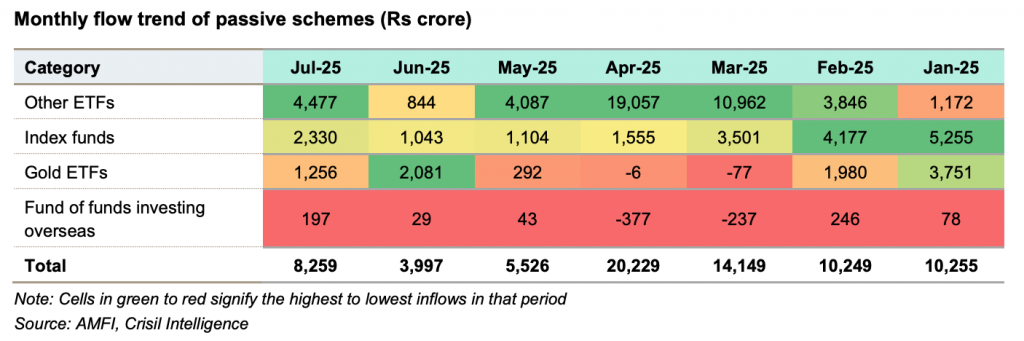
Source: AMFI, Crisil Intelligence
This rapid growth reflects a maturing investor base seeking diversified, cost-effective investments.
Table of Contents
Understanding ETFs in the Indian Context
What exactly is an ETF?
As mentioned, an ETF combines the features of stocks and mutual funds. This means with one ETF, you get exposure to a wide range of asset classes, including equities, debt, commodities, and multiple securities at once, making investing simpler for a newcomer.
How ETFs Differ from Mutual Funds
While ETFs and mutual funds both offer a way to invest in a diversified basket of securities, they have several fundamental differences. The primary distinction lies in how they are traded and priced. Let’s take a look at a comprehensive comparison of both.
| Aspect | ETFs | Mutual Funds |
| Trading & Pricing | Traded on stock exchanges throughout the day like stocks. Price changes in real time. | Traded on stock exchanges throughout the day like stocks. Price changes in real time. |
| Demat Requirement | Require a demat and trading account to invest. | Can be purchased directly from AMCs or distributors. No demat account needed. |
| Unit Structure | Units linked to benchmark values (e.g., 1/100th of Nifty 50 ETF). Provides an explicit, tangible reference for the ETF’s value during trading hours. | Value shown through daily NAV without such benchmark linkage. |
| Cost & Transparency | ETFs have lower expense ratios | Mutual funds have higher management fees. |
Trading and Pricing: ETFs are traded on stock exchanges throughout the day, just like individual stocks. Their price is determined by real-time supply and demand in the market. In contrast, mutual fund units are purchased or redeemed at the Net Asset Value (NAV), which is calculated only once at the end of each trading day based on the closing prices of the underlying assets.
Account Requirements: To invest in ETFs, you must have a demat and trading account, as they are bought and sold on the stock exchange. Mutual funds can often be purchased directly from the Asset Management Company (AMC) or through various distributor platforms without requiring a demat account.
Unit Structure: A mutual fund’s value is represented by its daily NAV. An ETF unit, however, is often designed to represent a specific, measurable fraction of its underlying benchmark. For instance, a Nifty 50 ETF unit might be structured to be approximately 1/100th of the Nifty 50 index value, or a Gold ETF unit could be equivalent to one gram of gold. This direct linkage provides a clear, tangible reference for the ETF’s value during trading hours.
Cost and Transparency: ETFs, being passively managed, generally have lower expense ratios compared to actively managed mutual funds. Additionally, the portfolio holdings of an ETF are disclosed daily, offering a higher degree of transparency than mutual funds, which typically report their portfolios on a monthly or quarterly basis.
Types of ETFs in India
When discussing Exchange-Traded Funds, not every type of ETF is currently available in India. While the global ETF universe spans a wide range of asset classes and strategies, the Indian market is still evolving.
Index Equity ETFs: These track broad market indices or specific segments. For example, say a Nifty 50 ETF holds the 50 largest Indian companies in the Nifty index, giving instant exposure to the overall market. There are also sectoral ETFs focusing on sectors like banking or technology to target specific industries.
Commodity ETFs: Gold ETFs are quite popular in India, allowing you to invest in gold without holding physical gold. There are also newer commodity ETFs (like Silver, Copper, Aluminium ETFs) for diversifying into precious metals. Gold ETFs have been used as a hedge against inflation and saw surging interest during past market crises.
International ETFs: These ETFs enable global exposure by tracking foreign indices. For instance, Indian investors can buy ETFs that track the Nasdaq-100 or S&P 500, gaining exposure to US markets through their regular demat account.
Debt ETFs: Debt and bond ETFs (such as the Bharat Bond ETFs) allow investors to invest in fixed-income securities. These track indexes of government bonds or corporate bond portfolios, providing a stable income investment option with the flexibility of trading on the exchange.
Today, there are over 250 ETF schemes tracking dozens of different indices. The market has come a long way from a single product in 2001. Regulatory initiatives by SEBI have further fuelled the growth in ETF listings and assets.
Disclaimer: The above ETF examples are intended solely for educational purposes, offering conceptual clarity to investors based on the information provided.
How to Invest in ETFs?
Investing in ETFs is a process similar to trading individual stocks, as they are listed and traded on stock exchanges. To begin, an investor is required to have a demat account and a trading account, which can be opened through a registered stockbroker. Once these accounts are set up, you can buy or sell ETF units through your broker’s trading platform during market hours. The price of an ETF fluctuates throughout the trading day based on supply and demand, allowing you to purchase units at real-time market prices, just as you would with a company’s shares.
Key Benefits of Investing in ETFs
Diversification Made Simple: One of the biggest advantages of ETFs is instant diversification. By purchasing one ETF, you get exposure to a basket of stocks or assets, rather than putting all your money into one company. For example, buying a Nifty 50 index ETF effectively makes you a part-owner of all 50 companies in the Nifty 50 index.
Cost-effectiveness: ETFs are known for their low cost, which is a key reason they’re gaining popularity. Because they are passively managed (just tracking an index without active stock-picking), their expense ratios tend to be much lower than those of regular mutual funds.
Liquidity & Flexibility: Another perk of ETFs is the flexibility they offer in trading. Unlike traditional mutual funds, which can only be bought or sold at the end-of-day net asset value (NAV), ETFs trade live on the stock exchange throughout the trading day. You can buy or sell ETF units at market prices anytime during market hours, just like shares of a company.
Transparency & Simplicity: Since an ETF typically tracks a known index or asset, you always know what you’re investing in. The indicative NAVs are available in real time to an investor, and so is the basket of securities that comprises the portfolio. If you buy a Sensex ETF, you can be sure it holds the 30 Sensex stocks in the same proportions as the index.
Variety of Choices: ETFs come with a lot of choices to suit your investment goals. You can find ETFs covering nearly every major asset class and strategy, ranging from broad equity exposure to a specific sector. Looking for a safe asset or inflation hedge? Gold and Silver ETFs are available to add commodities to your portfolio.
Accessibility & Global Exposure: Through Indian ETFs, you can gain exposure to global markets and diverse assets with ease. For example, several Indian fund houses offer international ETFs or Fund-of-Fund ETF schemes that track US indices like the Nasdaq-100 or S&P 500. By purchasing these on the NSE/BSE, an Indian investor effectively buys a slice of the US tech or broader market, without needing any overseas account or complicated forex transactions.
Challenges & Considerations for Indian Investors
While ETFs offer many benefits, it’s also important to be aware of a few challenges and considerations, especially in the Indian context:
Liquidity Concerns: Not all ETFs in India are highly traded. Some niche or new ETFs see low trading volumes, which can result in a bigger bid-ask spread (the difference between buy and sell price). Low liquidity might make it slightly harder to buy/sell large quantities at a fair price. That said, liquidity is improving as retail participation grows, and the most popular ETFs (like Nifty/Sensex ETFs or Gold ETFs) generally have sufficient volume.
Tracking Error: ETFs aim to replicate an index, but in practice, there can be a small difference between the ETF’s returns and the index’s returns. This difference, known as tracking error, arises due to fund expenses, cash holdings, and execution lags. It’s wise to check an ETF’s tracking record.
How are ETFs Taxed in India?
In India, the taxation of Exchange-Traded Funds (ETFs) depends entirely on the underlying asset they track.
Taxation is primarily applied in two ways:
Capital Gains: Profit from selling ETF units.
Dividends: Income distributed by the ETF.
Here’s a detailed breakdown of how different types of ETFs are taxed as of Financial Year 2025-26:
Equity ETFs
An ETF is classified as an “Equity ETF” if it invests at least 90% of its corpus in listed Indian equities. They are taxed similarly to equity stocks.
• As per Section 112A of the Income Tax Act, long-term capital gains exceeding Rs 1.25 lakh before 23 July 2024 will be taxed at 10%, while those sold on or after 23 July 2024 will be charged at the rate of 12.5% without indexation.
• As per Section 111A of the Income Tax Act, short-term capital gains tax will be applicable at the rate of 15% on the sale of assets done before 23 July 2024 and 20% on those sold on or after 23 July 2024.
The above tax structure remains the same for gold, debt, and other ETFs.
Indexation is a key benefit here. It adjusts the purchase price of your investment for inflation, which effectively reduces your taxable gain.
Dividend Taxation
If an ETF pays out dividends, this income is added to your total taxable income and taxed according to your income tax slab rate. If your total dividend income from a single fund house exceeds ₹5,000 in a financial year, a 10% Tax Deducted at Source (TDS) is applicable.
Disclaimer: The above information is intended solely for educational purposes. Please consult your financial advisor before investing.
To Wrap Up
ETFs have truly changed the investment landscape in India by making investing simpler, cheaper, and more accessible. For beginners, ETFs offer a friendly entry into the markets. You can start with even a single unit and get a diversified portfolio.
To sum up, ETFs in India offer diversification made easy, cost savings, liquidity, transparency, and a world of investment options. Whether you’re just starting to invest or looking to refine your strategy, exploring ETFs could be a way to invest in your financial future.
For more educational content like this, please refer to the Zerodha Fund House blog.
Disclaimers:
An Investor education and awareness initiative by Zerodha Mutual Fund.
Know Your Customer: To invest in the schemes of Mutual Fund (MF), an investor needs to be compliant with the KYC (Know Your Customer) norms and the procedure is -> Fill the Common KYC (CKYC) application form by referring to the instructions given below:
Enclose self-certified copies of both proof of identity and address. For Proof of Identity, submit any one document – PAN/ passport / voter ID/ driving license/ Aadhaar / NREGA job card/ any other document notified by central government. Proof of address, submit any one document which is the same as the proof of identity, except for PAN (since this document does not specify the address). If your permanent address is different from the correspondence address, then you need to submit proof for both the addresses. Documents Attestation – By any one from the authorized officials as mentioned under instructions printed on the CKYC application form. PAN Exempt Investor Category (PEKRN) – Refers to investments (including SIPs) in MF schemes up to INR 50,000/- per investor per year per Mutual Fund. This set of investors need to submit alternate proof of identity in lieu of PAN. In Person Verification (IPV) – This is a mandatory requirement and can be done by the list of officials mentioned in the instructions printed overleaf on the CKYC application form. Please submit the completed CKYC application form along with supporting documents at any of the point of acceptance like offices of the Mutual Fund/ Registrar, etc.
Investors may also complete their KYC online through Aadhar OTP-based authentication. Visit the respective fund house website or contact their customer care to know more about the process.
Modification to existing details like address/ contact details/ name etc. in KYC records – For any modifications to be done to the existing KYC details, the process remains same as mentioned above, except that only the details to be changed needs to be mentioned on the form along with PAN/ PEKRN and submitted with the relevant proofs.
Modification to your existing details like contact details/ name/ tax status/ bank details/nomination/ FATCA etc in Fund House records – Please visit the website of the respective Fund House to understand the procedure to update the details (if published) OR reach out to the customer service team of the respective Fund House.
Dealing with registered Mutual Funds shall be part of the blog at the end of the blog
Investors are urged to deal with registered Mutual Funds only, details of which can be verified on the SEBI website (www.sebi.gov.in) under Intermediaries/ Market Infrastructure Institutions.
Redressal of Complaints shall be part of the blog at the end of the blog
If you have any queries, grievances or complaints pertaining to your investments, you may approach the respective Fund House through various avenues published on their website. If you are not satisfied with the responses provided by the Fund House, you may then register your complaint on SCORES (Sebi Complaints Redress System) portal provided by SEBI for which the link is -> https://scores.sebi.gov.in
Other Disclaimer: The Content of this article/document is for educational and informational purposes only and should not be construed as financial advice. Please consult your financial advisor for advice suited to your specific circumstances.
Investing in mutual funds and other financial products involves risk, including the potential loss of principal. Past performance is not indicative of future results. Before making any investment decisions, investors should conduct their own research and seek advice from qualified financial advisors to ensure that the respective products and strategies are suitable for their specific financial situation and objectives.
Mutual Fund investments are subject to market risks, read all scheme related documents carefully.

Active on Twitter, my favourite pastime entails (but is not limited to) discussing movies, fiction novels. A forever music enthusiast, I love to strum some chords on my guitar from time to time.
- Emergency Fund 101: How Instant Redemption Fits In - Mar 12, 2026
- How to Pick Your First Investment: Here’s a Simple Guide - Jan 15, 2026
- Multi-Asset Investing: A Balanced Approach for Indian Investors - Nov 20, 2025