
Last Updated on Jan 30, 2026 by Harshit Singh
Have you heard about the “eighth wonder of the world”? It’s not a historic monument but a financial concept in long-term investing: compound interest.
In simple terms, compound interest is when your money earns returns, and then those returns start earning more returns. This is where the power of compounding comes into play.
Let’s dive deeper.
Table of Contents
What is Compounding?
Compounding is the process of earning interest on the money originally invested (principal) and on the interest that gets added to it over time. When you invest, you earn interest (or returns) on your initial amount (the principal).
With compounding, your earnings get added to your original amount, and then you start earning interest on the total amount (i.e., original amount + interest) and so on. In other words, you not only earn returns on your original investment, but also on the returns themselves from previous periods.
To understand this better, let’s compare simple interest versus compound interest.
Simple interest is calculated only on the original principal, whereas in compound interest, the interest you earn gets added to your original amount.
| Aspect | Simple Interest | Compound Interest |
| Definition | Interest is calculated only on the original amount (principal). | Interest is calculated on the principal plus the accumulated interest earned from previous periods. |
| Growth Pattern | Grows in a straight line (linear). | Grows in an upward curve line (exponential). |
| Formula | SI = (P × R × T) / 100 | A = P × (1 + R/N/100)^(nt) |
| Example (₹1,00,000 at 10% for 3 years without inflation-adjustment) | ₹30,000 total interest → Final amount = ₹1,30,000 | ~₹33,100 total interest → Final amount ≈ ₹1,33,100 |
| Best For | Short-term loans or fixed deposits with simple return structures. | Long-term investments and potential wealth creation. |
In the table above, SI stands for simple interest, P is principal, R is the annual rate (%), and T is time (in years). Similarly, in the compound interest formula, A = amount, P = principal, r = rate of interest, n = number of times interest is compounded per year.
The interest earned from the principal amount for both simple and compound interests are not inflation-adjusted. Actual purchasing power depends on inflation, so real returns may differ when inflation is factored in, which is covered later in this article.
Disclaimer: The above table is intended solely for educational purposes, offering conceptual clarity to investors based on the information provided.
Why Does Compounding Matter in Investments?
Compounding is a cornerstone for long-term investing, and time does a lot of the heavy lifting for your money. This means you need consistent returns and enough time for compounding to work its magic.
Another reason compounding matters is when you start investing early. Money invested earlier and left alone to compound can result in a larger ending value rather than a greater amount invested later with less time to grow. Reinvesting earnings (such as interest, dividends, or profits) rather than withdrawing and investing again can give your investments more fuel to generate additional returns.
Compounding can also encourage disciplined behaviour. Knowing that patience and time are key to unlocking compounding benefits can motivate investors to stay invested through market ups and downs, rather than trying to time the market or chase quick gains.
How Does Compound Interest Grow?
The table below illustrates how ₹10,000 invested at 10% per annum compounded annually grows through a 10-year tenure:
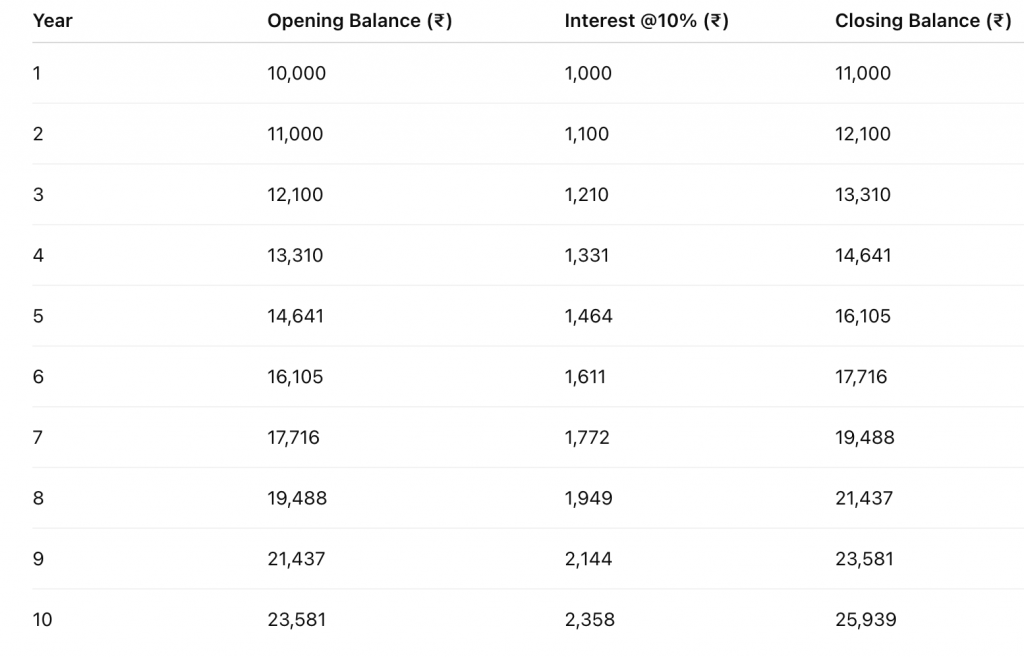
After 10 years, the investment of ₹10,000 grows to ₹25,939, without adjusting for inflation, often known as the snowball effect (details about snowball effect covered in this article)
The Snowball Effect of Compounding
Compounding takes into account the snowball effect.
This means that the growth picks up speed as your investment gets larger. In the early periods, your returns might seem small, like a tiny snowball. But over time, as those returns are reinvested, the investment gains mass and rolls faster. Eventually, the interest you earn itself starts generating more interest, resulting in your wealth accumulating more. Refer to the above table for a better understanding.
Consistently reinvesting your earnings (and adding new investments regularly, if possible) can help money grow better over time, provided the inflation remains low.
Compounding vs Inflation: The Real Return
While compounding can significantly grow your money, inflation is an important factor that can’t be ignored. Inflation is the rate at which prices for goods and services rise over time, eroding the purchasing power of your money.
In investing, there’s a big difference between nominal returns (the headline percentage growth of your money) and real returns (the growth of your money after accounting for inflation).
If your investment grows by 10% in a year but inflation is, say, 6%, your real increase in purchasing power is only about 4%. In other words, high inflation can eat into the gains from compounding.
Benefits of Compounding Over Time
Compounding offers several key benefits for wealth creation:
- Growth: As illustrated above, over long periods, compounding can turn even modest returns into significant wealth.
- Rewards Patience and Early Investing: The sooner and longer you invest, the more compounding periods you will have..
- Money Working for You: With compounding, your money earns returns, and then those returns start earning too. This may help your wealth grow faster over time
- Goal Achievement: Ultimately, the power of compounding can bring long-term goals (like retirement, education funds, etc.) within reach. It enables wealth to build up gradually and reliably, provided you give it time.
Limitations of Compounding
Despite its power, compounding comes with some important caveats and limitations:
- Taxes and Fees Reduce Compounded Gains: Capital gains taxes, dividend taxes, and various management or advisor fees may affect your returns, reducing the effective rate at which your wealth compounds.
- Market Volatility and Negative Returns: Compounding works best with steady, positive returns, but real-world markets are volatile and can turn negative. Negative or volatile markets (wide swings in returns) can drag down the overall compound growth.
- Time Dependency: Compounding’s benefits don’t appear overnight. Investors must be patient and keep their money invested for the long term to see the full benefit.
- Debt Compounding Works Against You: On the flip side, compounding in debts (like credit cards or loans) can drastically increase liabilities, trapping borrowers in a “debt spiral”.
Strategies to Minimise Compounding Limitations
- Stay Invested & Avoid Frequent Withdrawals: Withdrawals interrupt the compounding process and reset the “snowball effect.” Build a strategy in such a way that you won’t need to dip into your investments in case of short-term cash needs.
- Diversify: Spreading investments across asset classes (equity, debt, real estate, commodities like gold, silver) can potentially reduce the risk of underperformance in any one area.
- Automate Investments for Discipline: One common approach investors use is systematic investment plans (SIPs), which allow regular and automated contributions.
- Increase Contributions Gradually: As your income grows, step up your investment amounts rather than keeping them stagnant. SIP step-up features allow periodic increases, maximising total corpus over time.
The key takeaway is that when planning for long-term goals, you should consider real returns, not just nominal.. Many financial calculators and tools allow you to input an inflation rate to see inflation-adjusted projections. By calculating both nominal and real returns, you can get a clearer picture of your investment’s performance and whether it’s truly growing your wealth in practical terms.
Conclusion
Compound interest works through consistent rates of return* and the relentless passage of time. The power of compounding in investments lies in its ability to generate wealth gradually and steadily, turning even small sums into large amounts given enough time and reinvestment.
In practice, compounding tends to be more effective when money is invested early, stays invested over long periods, and earnings are reinvested consistently
This power is most effective when your returns outpace inflation, ensuring that your wealth grows not just on paper but in purchasing power.
For more educational content like this, please refer to the Zerodha Fund House blog.
*Past performance is not indicative of future results. Before making any investment decisions, investors should conduct their own research and seek advice from qualified financial advisors to ensure that the respective funds, products and strategies are suitable for their specific financial situation and objectives.
___________________________________________________________________________
Disclaimers:
An Investor education and awareness initiative by Zerodha Mutual Fund.
Know Your Customer: To invest in the schemes of Mutual Fund (MF), an investor needs to be compliant with the KYC (Know Your Customer) norms and the procedure is -> Fill the Common KYC (CKYC) application form by referring to the instructions given below:
Enclose self-certified copies of both proof of identity and address. For Proof of Identity, submit any one document – PAN/ passport / voter ID/ driving license/ Aadhaar / NREGA job card/ any other document notified by central government. Proof of address, submit any one document which is the same as the proof of identity, except for PAN (since this document does not specify the address). If your permanent address is different from the correspondence address, then you need to submit proof for both the addresses. Documents Attestation – By any one from the authorized officials as mentioned under instructions printed on the CKYC application form. PAN Exempt Investor Category (PEKRN) – Refers to investments (including SIPs) in MF schemes up to INR 50,000/- per investor per year per Mutual Fund. This set of investors need to submit alternate proof of identity in lieu of PAN. In Person Verification (IPV) – This is a mandatory requirement and can be done by the list of officials mentioned in the instructions printed overleaf on the CKYC application form. Please submit the completed CKYC application form along with supporting documents at any of the point of acceptance like offices of the Mutual Fund/ Registrar, etc.
Investors may also complete their KYC online through Aadhar OTP-based authentication. Visit the respective fund house website or contact their customer care to know more about the process.
Modification to existing details like address/ contact details/ name etc. in KYC records – For any modifications to be done to the existing KYC details, the process remains same as mentioned above, except that only the details to be changed needs to be mentioned on the form along with PAN/ PEKRN and submitted with the relevant proofs.
Modification to your existing details like contact details/ name/ tax status/ bank details/nomination/ FATCA etc in Fund House records – Please visit the website of the respective Fund House to understand the procedure to update the details (if published) OR reach out to the customer service team of the respective Fund House.
Dealing with registered Mutual Funds shall be part of the blog at the end of the blog
Investors are urged to deal with registered Mutual Funds only, details of which can be verified on the SEBI website (www.sebi.gov.in) under Intermediaries/ Market Infrastructure Institutions.
Redressal of Complaints shall be part of the blog at the end of the blog
If you have any queries, grievances or complaints pertaining to your investments, you may approach the respective Fund House through various avenues published on their website. If you are not satisfied with the responses provided by the Fund House, you may then register your complaint on SCORES (Sebi Complaints Redress System) portal provided by SEBI for which the link is -> https://scores.sebi.gov.in
Other Disclaimer: The Content of this article/document is for educational and informational purposes only and should not be construed as financial advice. Please consult your financial advisor for advice suited to your specific circumstances.
Investing in mutual funds and other financial products involves risk, including the potential loss of principal. Past performance is not indicative of future results. Before making any investment decisions, investors should conduct their own research and seek advice from qualified financial advisors to ensure that the respective products and strategies are suitable for their specific financial situation and objectives.
Mutual Fund investments are subject to market risks, read all scheme related documents carefully

Active on Twitter, my favourite pastime entails (but is not limited to) discussing movies, fiction novels. A forever music enthusiast, I love to strum some chords on my guitar from time to time.
- Emergency Fund 101: How Instant Redemption Fits In - Mar 12, 2026
- How to Pick Your First Investment: Here’s a Simple Guide - Jan 15, 2026
- Multi-Asset Investing: A Balanced Approach for Indian Investors - Nov 20, 2025